

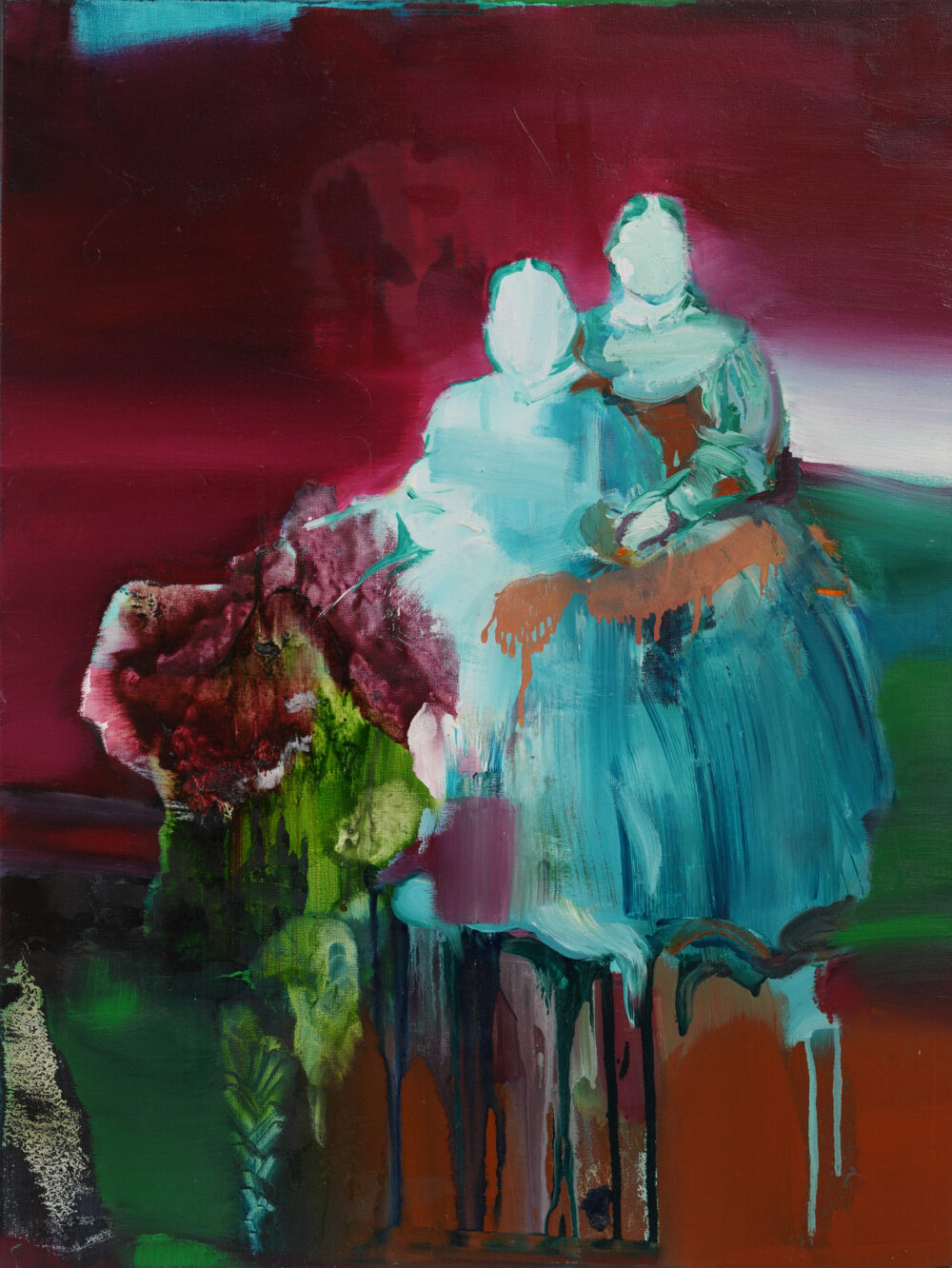
Bogna Błażewicz interviewed Aleksandra Winnicka ahead of the exhibition Wracaj Kwiecie do domu swojego/ Return, Flower, to Your Own Home.
Bogna Błażewicz: You welcome viewers into a mysterious, rather ominous, and yet visually colorful realm of stories about your female ancestors. What, in essence, is this exhibition about?
Aleksandra Winnicka: The show explores theatricality, nature, patriarchy, costumes, class, childhood, and sacral architecture.
BB: I have always perceived you as a rebel. What are you rebelling against when you tell stories about women?
AW: I am rebelling against the practice of women being forced into geopolitical, religious, and cultural masquerades – narratives that were not only invented by men in power but are also integral to a complex framework of social architecture.
BB: In a text available on your website, Marcin Burzyński writes the following about your paintings: “Ola Winnicka’s work may be read as a painterly manifesto – one that is simultaneously feminist and punk. She creates art that rejects the ideal of perfection, affirms imperfection, and recognizes the right to be angry, to feel emotions, and to exist outside the norm. Her paintings do not conform to the art market or the mainstream canon – they remain free, authentic, and defiant. This is precisely why they constitute such a powerful voice in contemporary art: a voice that reminds us that rebellion and tenderness can coexist, and that freedom begins where we reject the imposed constraints.” Would you agree with this assessment?
BB: In your artistic style austerity and roughness blend with poetry, and brutality goes hand in hand with … spirituality. What are the origins of these combinations?
AW: I have never really given it much thought. Perhaps it is simply the cruelty of nature, in which human beings – often plagued by inner conflicts – attempt to find themselves, usually to no avail. Questions concerning spirituality, aesthetics, and music – the areas in which things are created and brought to life, areas that evoke emotion, uplift, and can, in a positive way, embarrass us because we cannot understand them that well.
BB: You are an artist who operates across various domains of art, including music. In you move beyond painting – you have chosen to present installations as well. Are these two forms of expression particularly close to your heart, and best convey what you want to communicate?
AW: I have often noticed similarities between composing music and painting. I never make sketches and, in both cases, I begin with a landscape – a backdrop that transports me somewhere. And then, the stories come in. Similarly, this applies to sculpture, installation, and costume design.
An additional component in music is TIME but this “medium” is absent from flat, static images. In my paintings, one can see just how much I am searching for this movement, this air, this vibration – even through the intense use of colour. I need some kind of depth … Every so often, that depth takes the form of an unfolding narrative, however ephemeral it may be. There is a sense of community in such narratives – a sense of connection to something greater than what we are, in which we can sometimes find ourselves.
Choosing a medium is a very important decision. How can I best convey this “something”?” Here, I believe it is crucial to look beyond myself, beyond my individuality, with a sense of humility, so that I can best convey the story or provide inspiration to viewers.
