
The NET Manifesto, written in 1971 by Jarosław Kozłowski and Andrzej Kostołowski, proposed the free exchange of ideas, concepts, projects, texts, and other forms of artistic expression outside the official art circuit. Sent to a mailing list of people in over thirty countries, it crossed the borders of the Cold War order. The first reception of NET took place in early 1972 in a private flat in Poznań, but it was interrupted by a raid by the Security Service.
The Akumulatory 2 Gallery, founded by Jarosław Kozłowski with a group of Poznań art‑history students in 1972 in defiance of the restrictions imposed by the authorities, was both a continuation and an extension of that idea. Lacking institutional backing, it was housed in the Akumulatory student club at 7 Zwierzyniecka Street in Poznań. From 1981, it was co‑run by Hanna Łuczak. Akumulatory 2 served as a space for presenting diverse artistic approaches and contemporary art from around the world, without any fixed programme. Over the gallery’s nineteen years of operation, nearly two hundred events — exhibitions, performances, actions, and lectures — were organised. All were run on a voluntary basis and resulted from contacts not mediated by any institution.
The conceptual artist Goran Đorđević aptly described this network of relationships in a remark made during a discussion about informal artistic circles: “The history of contemporary art is a history of friendship.”[1]This idea is also taken up by Bojana Pejić, an art historian and curator, in the essay “A Politics of Friendship (Remembered),” published in the volume After Piotr Piotrowski: Art, Democracy and Friendship. The reference is particularly significant because NET and the collaborative activities within the Akumulatory 2 Gallery repeatedly figure in the later writings of Piotr Piotrowski, the historian of Central and Eastern European art.
Friendship, a recurring theme in writings about the art of this region, is for Pejić partly a methodological category: one way of practising art history. She treats it as an intellectual practice grounded in discussion and exchange, non‑competitive debate, mutual reading, and the interplay of interpretations. It also involves invoking views and reinterpreting them with the awareness that they are tools for further thinking, allowing one to correct or supplement one’s own perspective. Friendship, in Pejić’s account, is finally a non‑hierarchical relationship that recognises differences of position without turning them into a rule of subordination. This stance intertwines with Piotrowski’s proposal: a call for a horizontal history of art that does not replicate the hierarchy of centre and periphery.
Pejić draws her understanding of friendship as an asymmetrical relationship from Jacques Derrida’s The Politics of Friendship. For the philosopher, the figure of friendship is the apostrophe – an address toward someone whose presence is not certain and who may only yet become its recipient. Similarly, the NET manifesto did not find a ready-made community, but rather created the possibility of its coming into being. Friendship in this sense is never immediately given and reveals itself in anticipation. It constitutes a relationship stretched between addressing, sending and receiving; between the one who writes and the one who may never reply. As a promise, it always remains somewhat in the future, yet is at the same time linked to the past, to what has been left unsaid and can no longer be said, and to the replies that come too late or do not come at all.
The reception of NET thus involved numerous intermediaries who might be described as “third readers”. Some of them — for example the Security Service officers who developed the film from a camera seized during the first NET reception to inspect its contents, or the censors who seized parcels and works of art — entered this circulation against the sender’s wishes. As the American artist Emmett Williams recalled, “My arrival in Poland cost the local customs inspector the stamping of every sheet of paper. While these delicate rice papers were stamped on the reverse, the stamp could also be seen on the front. Thus, traces from Poland overlapped with traces from Japan.” The objects themselves – letters, envelopes, printed matter, and negatives – also acted as intermediaries. Their materiality, the risk of interception, access to printing materials, and the costs of postage all helped determine what could occur within the network. Today, however, those who treat NET as an ongoing obligation to respond – renewed through successive readings and work with the archive — enter this circulation in a different way.
Responding is also bound up with responsibility. We respond, first and foremost, to someone or something; we also respond for ourselves, for someone else or for something; and finally, we respond before someone or something. All three senses find material expression within NET. To respond for someone [odpowiadać za] is to sign your name, give an address, and help build the network. To respond to someone [odpowiadać komuś] is to collect a letter, return a work, pass on a contact, or take part in an exchange initiated by another’s invitation. To respond before someone [odpowiadać przed] is to enter into a relationship with the prevailing order and open it up – breaching it by joining a non‑hierarchical circulation.
Such an understanding of responsibility found its fullest practical expression in the Akumulatory 2 Gallery, described as “a unique forum dedicated to art,” in which “what happens in art determines what the gallery is”.[3] In practice, to be responsible before someone meant to be responsible for what occurs in art, rather than for an institution or the market order. In this context, non‑institutionality was linked to an active rejection of certain functions a gallery might perform in relation to art. It was intended to be “just a space,” and a flexible one at that – one adapting to various, often conflicting, viewpoints.
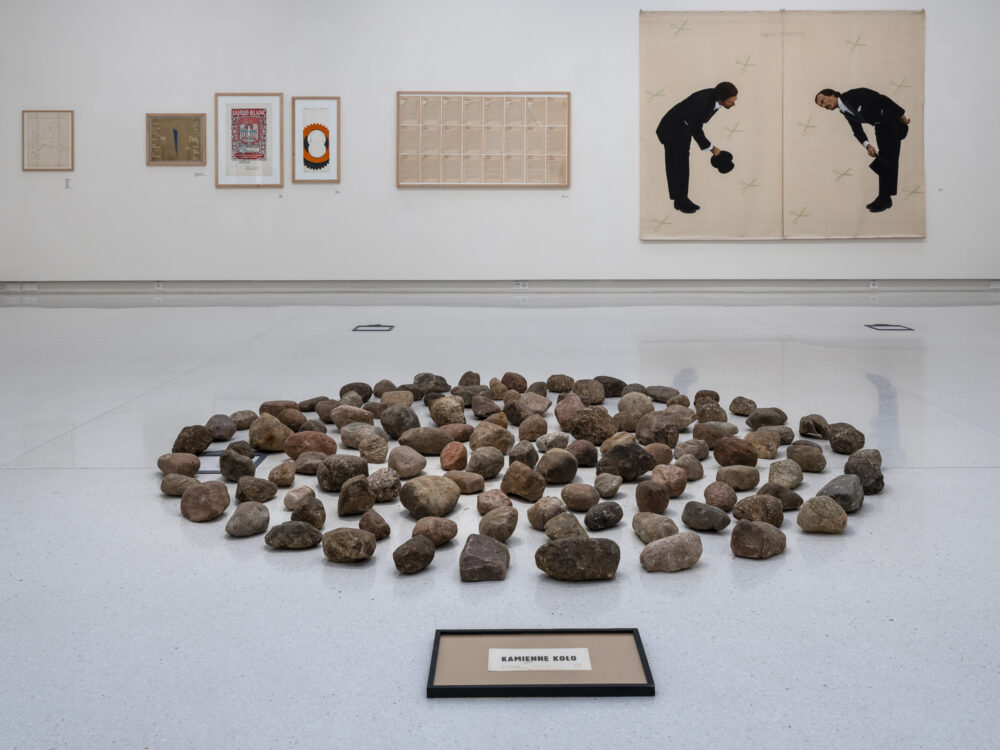
This understanding of the gallery’s role led to an almost complete rejection of group exhibitions. Over the Akumulatory 2 Gallery’s years of activity only a handful of group shows took place, and their very titles – such as Prywatne poglądy [Private Views, 1978] and Indywidualne mitologie [Individual Mythologies, 1980] – indicate that the idea of collectivity as a shared programme was alien to the Gallery. The exhibition Formy przyjaźni [Forms of Friendship], whose collective character derives from the very nature of the collection bequeathed to the Arsenał Municipal Gallery by Jarosław Kozłowski, continues this stance. It comprises works selected from a much larger whole and, in presenting them together, does not attempt to reconcile them.
Luiza Kempińska
[1] Victor Misiano, The Institutionalization of Friendship, in: Transnacionala: Highway collisions between East and West at the Crossroads of Art, ed. Eda Čufer, Ljubljana: Koda, 1999, p. 182, available online: https://www.irwin-nsk.org/texts/institualisation/
[2] Conversation with Emmett Williams, “Zeszyty Artystyczne” 1983, no. 1, p. 19.
[3] Akumulatory 2 Gallery, Grzegorz Dziamski in conversation with Jarosław Kozłowski, “Zeszyty Artystyczne” 1991, no. 5, p. 16.
curatorial team: Jarosław Kozłowski, Luiza Kempińska
Eric Andersen / Angelo de Aquino / Imre Bak / Andrzej Bereziański / Joseph Beuys / Włodzimierz Borowski / Natalia Brandt / Natalia Brodacka / Victor Burgin / William S. Burroughs / Giuseppe Chiari / Henri Chopin / Carlfriedrich Claus / COUM Transmissions (Cosey Fanni Tutti, Genesis P-Orridge) / Artur Cravan / Hanne Darboven / Mirtha Dermisache / Andrzej Dłużniewski / Stanisław Dróżdż / Gilbert & George / Wojciech Gorączniak / Tom J. Gramse / Peter Mandrup Hansen / Gerard Hemsworth / Geoffrey Hendricks / Margrit Kahl / Victor Kalinosi Mutale / Koji Kamoji / Pierre Keller / J.H. Kocman / Akira Komoto / Andrzej Kostołowski / Jarosław Kozłowski / Shigeko Kubota / Richard Long / Jerzy Ludwiński / Hanna Łuczak / George Maciunas / Piotr Macha / Inge Mahn / Andrzej Matuszewski / Joan Matthews / Yutaka Matsuzawa / Maryna Mazur / Ian McKeever / Yoko Ono / Géza Perneczky / Paweł Polus / Jerzy Rosołowicz / Ralf Samens / Mieko Shiomi / Mikołaj Smoczyński / Petr Štembera / Kishio Suga / Jarosław Szelest / Amikam Toren / Endre Tót / David Troostwyk / János Urbán / Ben Vautier / Franz Erhard Walther / Robert Watts / Lawrence Weiner / Emmett Williams / Krzysztof Wodiczko / Horacio Zabala