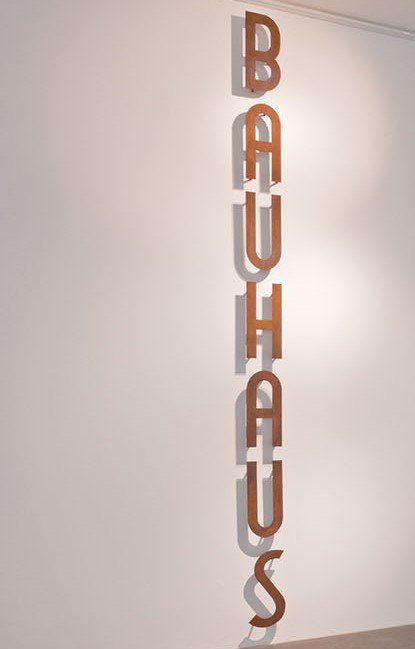
Rafał Jakubowicz’s Bauhaus draws on the typography used by Franz Ehrlich in the inscription incorporated into the entrance gate of KZ Buchenwald, “Jedem das Seine” (“To each his own”). A Bauhaus student (1927–1930), arrested as a Communist in 1935, Ehrlich was a prisoner at Buchenwald (1937–1939). When he regained his freedom, Ehrlich continued to work for the Nazis on the expansion of the camp, designing, among other things, barracks for the prisoners. After the war, he was a prominent GDR architect and a Stasi collaborator. Jakubowicz’s Bauhaus work was created for the Common Affairs exhibition at the Deutsche Bank KunstHalle in Berlin in 2016 (Ehrlich was involved in the reconstruction of the former Deutsche Bank headquarters, adjacent to the DB KunstHalle). The artist’s gesture entailed negotiating the work’s description with the bank. In the end, the description prepared by the artist and the curators of the exhibition (Julia Kurz and Stanislaw Welbel) became part of the work (as a so-called artist statement), while the bank submitted its own official description beneath the object, presenting a suitably smoothed-out biography of the German architect.
Rafał Jakubowicz – painter, video and installation artist, and art critic, born in 1974 in Poznań. He graduated from the Faculty of Art Education (1999) and the Faculty of Painting, Graphics Arts and Sculpture (2000) at the Academy of Fine Arts in Poznań. Since 2005 he is a Member of AICA. Employed as an associate professor at the University of Arts in Poznań, where he runs the Studio of Art in Social Space at the Faculty of Art Education and Curating. In 2002, he co-founded the art collective Wunderteam. In 2007, he was nominated for the Deutsche Bank Foundation’s Spojrzenia Award. In his artistic work, he uses various media. He exhibits in galleries and carries out projects in public spaces. Jakubowicz’s work addresses the theme of memory in the broadest sense of the term: the preservation, displacement, persistence, and disappearance of traces of historical and visual reality.
Jakubowicz’s best-known work is the installation Arbeitsdisziplin: a video in which a uniformed guard moves behind a wire mesh set up in front of a giant factory with the Volkswagen logo; a light box with a view of the factory emerging from behind barbed wire; and postcards presenting the same motif. Referring to Volkswagen’s infamous role in fascist Germany, the work depicts the oppressive aspect of the place, and speaks of the mechanisms of power that permeate reality, condition our everyday functioning, and persist stored in the social subconscious, waiting to reveal themselves under the most extreme circumstances.